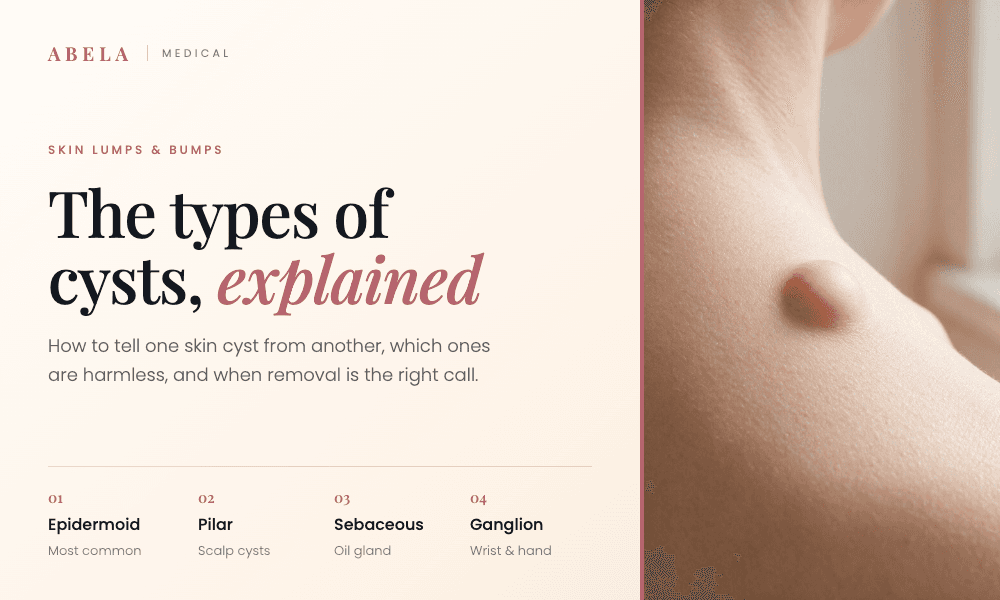
A cyst is a small lump under your skin. It holds fluid, keratin, or oil inside a thin sac. The most common types of cysts are epidermoid, pilar, sebaceous, milia, dermoid, and ganglion cysts. Most are harmless. Still, a few need a closer look, so it helps to know which type you have and when to act.
Most cysts grow slowly and cause no pain. They also rarely clear up by themselves, so a lump that sticks around for months is nothing unusual.
Key Takeaways
- Most skin cysts are harmless. They're not cancer.
- The lump's location and contents determine the kind.
- The most prevalent types are pilar and epidermoid cysts. Both are frequently referred to as sebaceous cysts.
- A small dark dot in the centre, called a punctum, is a strong clue.
- See a doctor if a lump grows fast, hurts, bleeds, or will not heal.
The Most Common Types Of Skin Cysts
Cysts come in several forms. The type depends on how it forms and where it appears. Here are the ones you are most likely to see.
Epidermoid cyst
This is the most common skin cyst. It forms when surface skin cells move deeper and get trapped. The trapped cells make keratin, which slowly fills the sac. You often see a small dark punctum on top. Epidermoid cysts show up on the face, neck, chest, and back. They feel firm and round.
Pilar cyst
From a hair root, a pilar cyst develops. For the most part, it rests on the scalp. Like a marble beneath the skin, it is hard and smooth. It hardly ever has a punctum, unlike an epidermoid cyst. More than one individual at home may have these cysts because they frequently run in families.
Sebaceous cyst
Sebaceous is a word many people use for any lump under the skin. In truth, most of these are epidermoid or pilar cysts. A true sebaceous cyst is less common. It comes from an oil gland and holds a thick, yellow substance. It can feel soft or firm to the touch.
Milia
Milia are tiny white bumps. They are much smaller than other cysts, often the size of a pinhead. You see them most around the eyes and cheeks. They hold keratin, just like larger cysts. Many people mistake them for whiteheads.
Dermoid cyst
A dermoid cyst is present from birth. It can hold hair, skin, and other tissue inside. It often sits near the eyebrow, scalp, or neck. These cysts grow slowly and feel firm.
Ganglion cyst
A ganglion cyst forms near a joint or tendon. The wrist is the most common spot. It holds a clear, jelly-like fluid. Its size can change over time. Some people call it a bible bump.
Other types include chalazion cysts on the eyelid, pilonidal cysts near the tailbone, and acne cysts deep in the skin. Each one looks a little different. Yet the same rule applies. If you are unsure, get it checked.
| Type | Where it appears | How it feels | Punctum | What is inside |
|---|---|---|---|---|
| Epidermoid | Face, neck, chest, back | Firm, round | Often Yes | Keratin |
| Pilar | Scalp | Smooth, firm | Rarely | Keratin |
| Sebaceous | Face, neck, back | Soft or firm | Sometimes | Oil (sebum) |
| Milia | Around the eyes, cheeks | Tiny, hard | No | Keratin |
| Dermoid | Eyebrow, scalp, neck | Firm | No | Skin, hair, tissue |
| Ganglion | Wrist, hands, ankles | Firm, smooth | No | Clear jelly |

Not Sure What That Lump Is?
- You learn what the lump is and whether it needs care
- The GMC-registered doctors at Abela Medical assess skin cysts in Leeds
- You leave with a simple plan and no pressure to book
How can you tell what type of cyst you have?
You cannot always name the type at home. Even so, a few simple checks give you a good clue.
- First, look for a punctum. That small dark dot points to an epidermoid cyst.
- Next, think about the spot. A lump on the scalp is often a pilar cyst. A lump on the wrist is often a ganglion cyst. Then press it gently. A cyst usually feels smooth and moves a little.
- Last, watch how it behaves. A cyst that stays the same for months is less of a worry than one that changes fast.
These hints are helpful but do not take the place of a proper check. A physician can verify the sort of lump by looking at it and feeling it. Sometimes a tiny tissue test or a scan provides a clear picture.
Cyst or something else?
Not every lump is a cyst. Some other bumps look and feel similar. Here is how they differ.
A lipoma is a soft, fatty lump. It moves easily and rarely has a punctum. A boil is a red, painful lump that comes from an infected hair root. An abscess is a pocket of pus and feels hot and sore. A swollen gland is a lump that comes up with a cold or an infection and then settles. A skin tag is a tiny, delicate skin flap, not a lump under it.
The table below sums up the main differences.
| Lump | How it feels | Key sign |
|---|---|---|
| Cyst | Smooth, firm, mobile | Often a punctum |
| Lipoma | Soft, squidgy | Moves easily, no punctum |
| Boil | Red, painful | Comes from a hair root |
| Abscess | Hot, sore, tense | Holds pus |
| Swollen gland | Tender lump | Settles after illness |
Most of these are harmless. Yet a hard, fixed lump that grows fast needs a check, because a few serious conditions can copy a cyst, more on that next.
Worried Your Cyst Might Be Serious?
- A GMC-registered doctor examines the lump and rules out anything serious
- Abela Medical offers cyst assessment and removal at its Leeds clinic
- You get honest advice and a clear next step

Which cysts should you never ignore?
Most cysts are safe to leave alone. But some signs mean you should see a doctor soon. Do not wait if you notice any of these.
- The lump grows quickly over the course of days or weeks.
- It hurts, feels hot, or turns red.
- It leaks pus or gives off a bad smell.
- It bleeds or forms a sore that will not heal.
- It feels hard, fixed, and will not move.
- It changes shape, colour, or texture.
- You feel unwell or run a fever alongside it.
These signs can point to an infection. In rare cases, a lump that seems like a cyst turns out to be something else. A hard, fixed lump that grows fast should always be checked to rule out skin cancer. It is far better to check and relax than to wait and worry.
One more rule matters here. Never squeeze or pop a cyst at home. This can push bacteria deeper, causing an infection. It can also leave a scar or make the cyst come back.
What to do if you find a cyst
Found a new lump? Do not panic. Most cysts are harmless and grow slowly. Watch it for a short while. Note its size, shape, and any change.
See a doctor if it grows, hurts, or shows any red flag above. A doctor can confirm what it is. If the cyst bothers you, a simple procedure can remove it under local anaesthetic. The right plan depends on the type, size, and location.
Conclusion
The main types of cysts are epidermoid, pilar, sebaceous, milia, dermoid, and ganglion. Most of them are benign. The position and contents of the lump indicate its nature. The punctum, the spot, and the sensation can help differentiate between them. The safest course of action is still to have it checked, especially if the lump hurts, grows quickly, or won't go away.
If a lump worries you, the GMC-registered team at Abela Medical can assess and treat cysts at its Leeds clinic. Book a cyst assessment in Leeds to get a clear answer and the right plan for your skin.
Frequently Asked Questions
What are the most common types of skin cyst?
The most common are epidermoid and pilar cysts. Many people call both sebaceous cysts. Milia, dermoid, and ganglion cysts are also common. Each one feels a little different and appears in its own spot.
How can you tell what type of cyst you have?
Look for a punctum, note the spot, and feel the lump. A dark dot points to an epidermoid cyst. A lump on the scalp is often a pilar cyst. Even so, only a doctor can confirm the type for sure.
Which cysts should you not ignore?
See a doctor if a lump grows fast, hurts, bleeds, or will not heal. A hard, fixed lump that grows fast also needs a check. These signs can mean an infection or, in rare cases, something more serious.
What is the difference between a cyst and a boil?
A cyst is a smooth lump. It holds a soft paste or oil inside. A boil is different. It turns red and sore from an infected hair, and it often bursts and drains on its own. A cyst just sits there and stays put.
Can a skin cyst turn into cancer?
Skin cysts are almost always benign, and they do not turn into cancer. Still, a few serious lumps can look like a cyst. That is why a hard or fast-growing lump should be checked.
Should you worry about a lump under the skin?
Most lumps under the skin are harmless cysts. Watch for fast growth, pain, or a lump that feels hard and fixed. If you see any of these, get it checked without delay.