

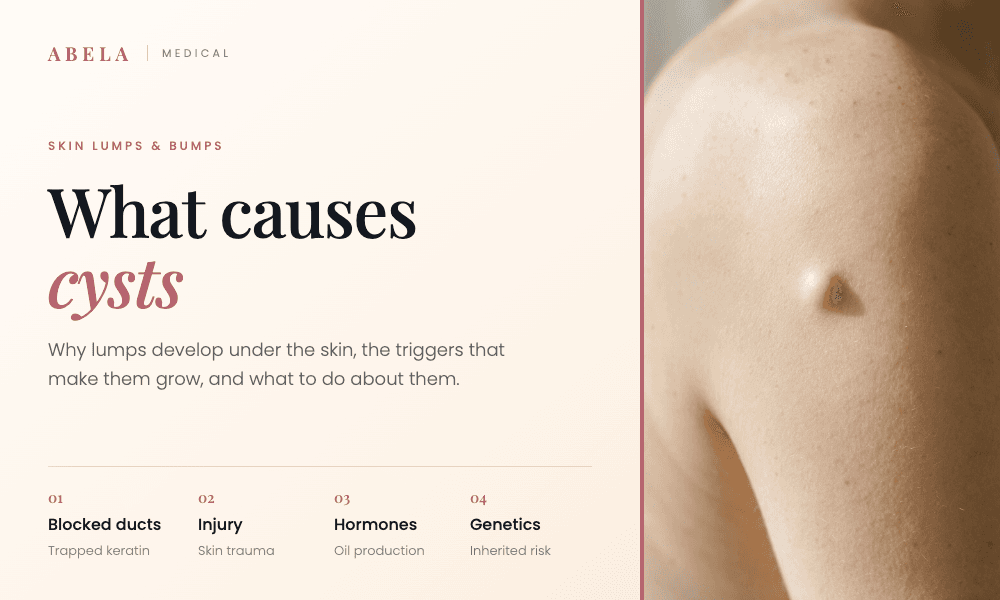
Cysts form when a small sac under the skin fills with fluid, keratin, or pus, most often after a gland, duct, or hair follicle becomes blocked. That is what causes cysts in most people, and it is why a cyst can show up almost anywhere on the body.
Most cysts are painless and harmless. Some grow, get infected, or return, so it helps to know what triggers them and when a lump needs a proper check.
Key Takeaways
- A closed sac beneath the skin is called a cyst. It can contain pus, fluid, or keratin.
- A clogged gland, duct, or hair follicle is the initial cause of most cysts.
- Hormones, minor skin injury, infection, and family history can raise your risk.
- Skin cysts are almost always benign, not cancer.
- A lump that grows fast, bleeds, or hurts needs a professional review.
What Causes Cysts to Form?
The exact cause is not always clear. Still, most skin cysts start the same way. A gland, duct, or hair follicle gets blocked, and the material that should drain away gets trapped instead. Over time, that trapped material forms a sac.
Here are the main reasons this happens.
A blocked gland or duct
Your skin has tiny glands that make oil to keep it soft. If the opening of one gets blocked, the oil has nowhere to go. It builds up behind the block and slowly forms a cyst. This is the single most common cause.
Trapped keratin
Keratin is a protein in the top layer of your skin. Sometimes skin cells move inward instead of falling away as normal. The keratin then gets trapped under the surface and packs into a sac. This is how an epidermoid cyst forms.
Skin injury or irritation
A minor cut, a graze, or repeated rubbing can disturb the skin. Skin cells can be pushed deeper than they should be. They then multiply and form a sac below the surface. Cysts sometimes appear after acne, a small wound, or an old scar.
Hormones
Hormones control how much oil your skin makes. When hormone levels shift, your glands can produce more oil and block more easily. That is why cysts are more common around puberty, during the menstrual cycle, and near menopause.
Infection
When your body fights germs, it can wall off the infected spot to protect the rest of the skin. That walled-off pocket can fill with pus and form a cyst. This is common with the deep, sore spots seen in severe acne.
Family history and rare conditions
Some people are simply more prone to cysts, and this can run in families. In rare cases, an inherited condition such as Gardner syndrome makes many cysts more likely. Most people with a cyst have no underlying illness at all.
A few other factors play a smaller role. Certain medicines, the human papillomavirus, and long-term sun damage can each raise the risk in some people.

Not Sure What That Lump Is?
- Find out whether a lump is a simple cyst or something that needs more care
- Get a clear diagnosis without a long wait
- Have your options explained in plain, simple terms
What Causes Different Types of Skin Cyst?
Not every cyst forms for the same reason. The type often depends on where it starts and what gets trapped inside. Here is a simple guide to the common types of cysts.
Epidermoid cyst
The most common skin cyst. It develops when keratin gets stuck beneath the epidermis. People often call it a sebaceous cyst, though the difference between an epidermoid and a sebaceous cyst is small but real.
Pilar cyst
Starts around a hair root, most often on the scalp. It also fills with keratin. These cysts tend to run in families.
Sebaceous cyst
A true sebaceous cyst arises from an oil gland and contains oily fluid. It is less common than the two above. The everyday use of the term often points to an epidermoid or pilar cyst instead.
Acne cyst
Deep, sore acne can create a cyst when a pore becomes blocked and then infected. The area swells as pus builds up under the skin.
Meibomian cyst/chalazion
Tiny glands along the edge of your eyelid can block and swell. This forms a small, firm lump on the lid known as a chalazion.
Why Do Cysts Come Back?
A cyst can return for two main reasons. First, the sac has a wall. If that wall is not fully removed, it can fill up again. This is why a cyst that is only drained often comes back later. Second, the cause may still be there. If acne, hormones, or a family tendency set off the first cyst, they can set off another one too.
Are Cysts Dangerous?
Almost all skin cysts are benign. That means they are not cancer, and they do not spread. Many cause no trouble beyond their appearance. Even so, a cyst can become infected, and an infected cyst can turn red, hot, and sore. A large cyst can also press on the skin or catch on your clothes.
Rarely, a lump that looks like a cyst turns out to be something else. That is why any lump that changes fast or behaves oddly deserves a professional look.
Cyst Warning Signs You Should Never Ignore
Most cysts are safe to leave alone. A few signs, though, mean you should see a GP or a skin specialist. Get a lump checked if it:
- grows quickly or changes shape
- bleeds on its own, without a knock or scratch
- breaks the skin or forms an open sore
- feels hard, or fixed in place rather than loose
- turns red, hot, and painful, which can point to infection
- comes back again and again after it was removed or drained
If a lump does any of these, book a review rather than wait. An early check gives you peace of mind and, if needed, faster treatment.
Tired of a Cyst That Won't Stay Away?
- The whole sac wall is removed, not just the lump
- The procedure is done under local anaesthetic in a single visit
- Clear aftercare lowers the chance of a repeat

Can You Prevent Cysts?
You cannot always stop a cyst from forming, and that is not your fault. Some causes, like your genes, are out of your control. Still, a few simple habits can lower your risk and help you avoid trouble.
- Do not squeeze or pick at a lump, as this can push infection deeper.
- Keep your skin clean to lower the risk of blocked glands.
- Treat acne early, since severe acne can lead to cysts.
- See a professional for any cyst that comes back more than once.
Conclusion
Thus, what is the cause of a cyst? Most of the time, cysts start as simple blockages. Material accumulates beneath the skin until it forms a sac when a gland, duct, or hair follicle becomes clogged. A hormonal component can be present. A minor injury, an infection, or a family history of cysts may also bring this on. The good news is that most skin cysts are harmless. Nevertheless, a professional should be consulted if the lump develops rapidly, bleeds, or comes back.
If you would like a cyst checked or removed, the team at Abela Medical provide cyst treatment in Leeds with a clear diagnosis and safe, gentle removal.
Frequently Asked Questions
What is the main cause of a cyst?
The main cause is a blocked gland, duct, or hair follicle. When the material inside cannot drain away, it gets trapped and slowly forms a sac under the skin.
Does stress cause cysts?
Stress does not directly cause cysts. It can, however, make skin conditions like acne worse and affect your hormones. In some people, that may lead to more cysts.
Why am I suddenly getting cysts?
Cysts can appear at any time. Common triggers are hormone changes, acne, a minor skin injury, or a family tendency. Often there is no clear reason at all. If many appear at once, see a GP to rule out an underlying cause.
Do skin cysts go away on their own?
Small skin cysts can settle down or shrink, and some stay quiet for years. The sac usually stays under the skin, though, so the cyst can return. A cyst that bothers you can be removed for good.
What vitamin deficiency causes cysts?
No vitamin or mineral deficiency causes skin cysts. They originate from blocked glands and hair follicles, not from your diet. A good diet promotes healthy skin, but it will not clear an existing cyst.
When should I worry about a cyst?
If a lump develops quickly, bleeds on its own, becomes an open sore, feels hard or fixed, or becomes red and painful, consult a specialist. A recurring cyst is also worth a review.